Welcome to the latest chapter of Ida’s evolution! This release is brimming with groundbreaking improvements that make Ida more knowledgeable, generative, and versatile than ever. Whether you’re here to geek out about generative AI, explore new integrations, or dive into the nitty-gritty of release notes, we’ve got you covered. Let’s break it all down!

Before we start, let’s review Ida’s Multi-Level AI system. Ida can intelligently choose different AI methods and models depending on each use case giving you the best of both worlds. Worried about personal data, leakage or hallucinations? No problem, Ida’s Level 1 provides fully human supervised output that meet the stringent requirements of “no surprises”. These models are dedicated and fine-tuned to each client.

Do you want a broadly helpful bot without having to spend the human supervision time? Ida’s Level 3 uses Ida Knowledge to generate answers automatically informed by your policies and guardrails where you need them. Level 2 is a blend of these benefits offering the time-savings features of generative AI, with the need to have human supervision. Without further ado, let’s get to the release…


🚀 Highlights of This Release

New Ida Knowledge Boosters: Supercharge Your Knowledge Base

Ida just got a lot smarter! Now, you can integrate structured data to handle use-cases like:

  • Company directories: Find the right employee in no time
  • Facilities databases: Let Ida guide users to the right room, building, or office
  • Course catalogs: Perfect for higher ed, Ida can now assist with course searches

The best part? These boosters can connect to a variety of external enterprise applications, such as:

  • Salesforce / ServiceNow: Ida can learn from your KB articles and tickets to provide amazing answers
  • Canvas: Answer student questions about the coursework at hand, curated by your instructors.

Generative AI Improvements

Ida’s generative AI continues to evolve. Here’s what’s new:

  • Debug Tools: Pinpoint issues faster and fine-tune your AI experience
  • Improved Performance: Ida Web Agents are more powerful and capable
  • Enhanced Formatting & Reporting: Deliver answers with polish and precision

Level 3 Intelligence: Smarter Contextual Conversations

Ida’s advanced Level 3 AI is stepping into the spotlight, bringing even more context-aware capabilities:

  • When a user’s query falls just short of perfection, Ida can suggest helpful Level 1 or Level 2 questions to guide them along.
  • Promotions now support suggestions for Level 3 generative queries, making conversations even more dynamic.

📋 Full Release Notes

Here’s everything we’ve packed into this powerhouse update:

  • Level 3 Ida can now suggest Level 1 or 2 questions when the user’s question is close.
  • Allow promotions/suggestions to suggest Level 3 generative questions.
  • Beta availability of Ida Knowledge Boosters.
  • New Ida Knowledge Booster Configuration Pages.
  • Salesforce Transfer to Live Chat Adapter.
  • Additional Ida Knowledge process fail-safes for stability.
  • Improvements to exiting a skill in T2 conversations.
  • Generative AI Enhancements:
    • Debug tools for troubleshooting.
    • Rich formatting improvements.
    • Performance boosts.
  • Fixed issues:
    • Debug info appearing in rating reports.
    • Web channel style conflicts affecting chat design.
    • Missing data in question use count reports.
    • Labels in daily conversation and thumbs reports.
    • Re-process updates for Ida Knowledge web agents.
  • New Reporting Features:
    • Multi-Level AI system report title updates.
    • Level filters in usage reports.
    • Enhanced context handling for Level 3 use cases.
    • User feedback report/chart enhancements.
    • Consolidated thumbs data into reports.
  • XML and ZIP file support in Ida Knowledge.
  • Improvements to console analytics for Level 3.
  • SmallTalk inactivation option for clients.
  • Refined labels in Conversation Logs.
  • Improved formatting for Level 3 answers.
  • Debugging and sourcing tools for Knowledge.

💡 What Does This Mean for You?

This release is all about empowering your team to do more with less friction. Whether it’s faster support, smarter integrations, or richer conversations, Ida is evolving to meet your growing needs. With these updates, Ida continues to set the standard for conversational AI.

So, go ahead—tap into the new Knowledge Boosters, marvel at the improved generative AI, and explore the power of Level 3 contextual intelligence. Your users (and your support teams) will thank you.

What’s your favorite new feature? Let us know—we’d love to hear how you’re making the most of these updates. Until next time, happy chatting!

Contact Us


Have you implemented Oracle Fusion applications? Are you planning on it?

Oracle Fusion is a powerhouse for modern enterprise operations, giving you access to cutting-edge cloud capabilities. Not to mention, with Oracle Cloud, you’re primed to leverage the full potential of AI.

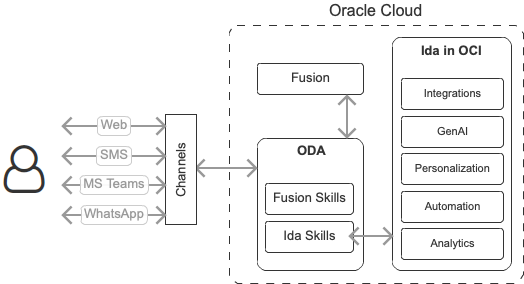
But here’s the thing: not all AI bots or AI agents can work inside Oracle Fusion due to security restrictions. This compatibility question looms large for those looking at AI in their Fusion deployment. Enter Ida, the AI agent that doesn’t just fit but thrives alongside Fusion. Built on the same Oracle Digital Assistant (ODA) platform, Ida plugs right in and supercharges your Fusion investment.

Let’s dive into why Ida and Fusion make the ultimate dream team for taking your AI game to the next level.

The Best of Both Worlds

Fusion customers face a classic dilemma. You want the seamless, pre-built Oracle Fusion chatbot Skills, but you also crave an AI agent that can do more than just Fusion.

That’s where Ida steps in. Think of Ida as the all-in-one AI agent that goes beyond boundaries. Not only does Ida seamlessly blend Fusion Skills into its functionality, but it also brings its own robust skillset to the table.

  • Enhance Fusion Skills: Ida can upgrade the out-of-the-box Fusion chatbot Skills, making them smarter, more intuitive, and better suited to your enterprise.
  • Broad Integrations: With integration adapters for systems beyond Fusion, Ida becomes your go-to AI for enterprise-wide needs, from IT helpdesks to facilities.
  • Omnichannel Deployment: Want your Fusion-powered AI to appear on MS Teams, SMS, WhatsApp, or other platforms? Ida makes it happen with ease.
Fully Oracle Cloud Native Architecture

Exclusive Access to Fusion

Not every bot gets a backstage pass to Fusion’s UI. For a chatbot to show up in the Fusion environment, where it matters most to your users, it must be built on the ODA platform. This rules out most of the bots in today’s market.

Ida, however, is different.

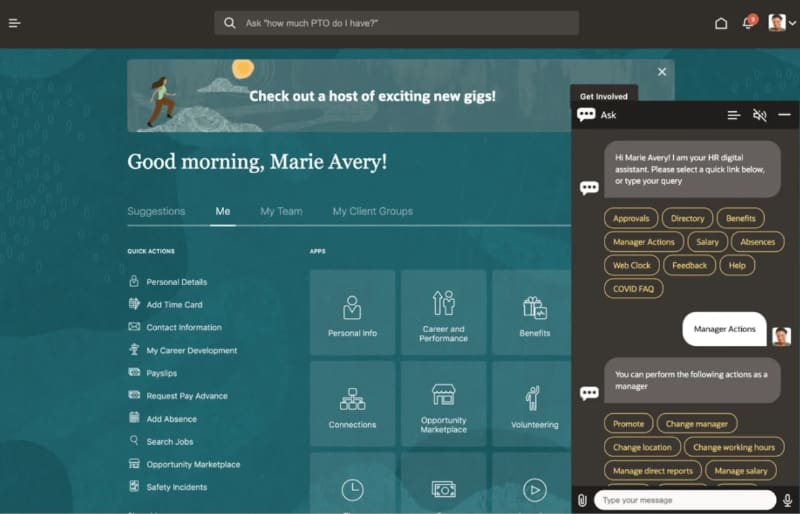
  • Ida can run inside Fusion’s UI, appearing as a familiar chat icon within HCM Cloud, ERP Cloud, or Student Cloud interfaces.
  • Ida can mix native Fusion Skills with its own, creating a powerful hybrid bot that works flawlessly across domains.
  • Ida can extend that chat experience beyond Fusion by embedding itself into service desk pages, intranet sites, and beyond for a true omnichannel strategy.
Fusion's ODA Channel
Fusion UI with Chat

Upgrade Fusion AI to Next-Level AI

Oracle Fusion gives you access to Oracle Cloud’s AI features, but Ida helps you unlock their full potential enterprise-wide.

Why settle for good when you can go great?

Employees rarely stick to one domain when they need help. HR questions often lead to IT requests, facilities inquiries, or procurement concerns. Ida handles these transitions effortlessly, thanks to its cross-domain capabilities.

Ida can leverage advanced generative AI models for automation far beyond Fusion’s native capabilities. All this happens seamlessly, with no extra headaches for your team. Plus you get the premium support you expect from the Ida Managed Service Team. The results can be amazing.

Reduce Human Wait Times over 50%

In Closing

Every Oracle Fusion license comes with access to the Oracle Digital Assistant platform, which means you’re already halfway to unlocking Ida’s full potential. By running Ida on this same platform, you:

  • Reduce licensing costs: No need for redundant AI solutions when Ida runs on your existing ODA infrastructure.
  • Deploy within Fusion: Ida can be accessed through the chat icon right inside Fusion apps.
  • Unlock enterprise-wide AI: Ida brings AI to every corner of your organization, not just Fusion applications.
  • Ensure total data security: Everything stays within the trusted Oracle Cloud environment.

For Fusion customers looking to achieve next-level AI at a competitive price, Ida is the perfect match. It’s the ultimate integration of cutting-edge AI, seamless compatibility, and enterprise security.

Ready to turbocharge your Oracle Fusion investment? Contact us below and learn more about how Ida can take you there.

Contact Us

Imagine a world where every software application you touch is powered by AI. It’s not just chatbots anymore. These days, AI is quietly woven into features across a variety of apps, often without us even realizing it. As this trend continues, it’s essential to understand how the AI in your software works, especially regarding the models it uses and how it handles your data.

You, ultimately, are the gatekeeper of your data’s safety. So, let’s arm you with the right questions to ask. For simplicity’s sake, we’ll focus on Large Language Models (LLMs) in this post. LLMs are becoming a staple in many applications, but they come at a cost—both financially and potentially in terms of data exposure. To offset the cost, most vendors are outsourcing these models, which means your data flows through these models as you interact with the software. But just how secure is it?

To answer that, let’s dive into the three most common ways LLMs are deployed today and what each means for your data security.

1. Shared Models on the Internet

Let’s start with the most common and cost-effective option today: shared LLMs accessible via a public API—like GPT-4. Here’s how it works: a software vendor integrates with a popular LLM API, which means every customer using that software is, in essence, sending data to the same endpoint.

While this setup is convenient, there’s a significant risk here. With countless vendors relying on the same model endpoint, it creates a prime target for malicious actors—a virtual honey pot. If this single-point-of-failure is compromised, all customers using the model are at risk. Even if your software vendor is secure, they’re one of many parties accessing this shared model, each potentially representing an entry point for an attack.

Lesson learned: cheap can be expensive. Know what your risks are when using publicly shared AI models.

Shared LLM models via public APIs can turn a cost-saving feature into a major risk. Know the trade-offs before you trust your data.

2. Shared Models Within Your Cloud Datacenter

For those looking to strike a balance between cost and security, many cloud providers offer LLM services accessible within their private cloud infrastructure. In this setup, the model (often open-source LLMs like Llama or Mistral) is shared among the cloud provider’s customers rather than the entire internet. Oracle, for example, also offers a partnership with Cohere to make LLMs available directly in their cloud environment.

With these models, you’re only sharing data within the cloud provider’s customer base, not with the wider world. Plus, this approach offers several security perks:

  • Data Privacy and Control: Cloud providers are more likely to offer advanced data privacy settings, especially beneficial for organizations with regulatory requirements like GDPR or HIPAA.
  • Private Access: Many clouds allow virtual private networks (VPNs) and private endpoints, avoiding the risks associated with sending data over the open internet.
  • Lower Latency: Keeping everything within the same cloud environment can reduce latency, which is critical for certain real-time applications. Public APIs, in contrast, can introduce lag as data moves to external servers.

In short, while you’re still sharing the model, the pool of users is smaller, and there’s added security by staying within a private cloud setup.

3. Dedicated LLM Models

At the top of the data security ladder, we have dedicated LLM models. This is, hands down, the most secure option—and, predictably, the most costly.

Dedicated LLMs mean all compute, memory, and storage resources are fully allocated to your organization. There’s no risk of “noisy neighbor” interference, and no other customers will be sharing the hardware. Industries with tight security and compliance requirements (think finance, healthcare, and government) will find this setup most beneficial for several reasons:

  • Complete Isolation: Your data and processing resources aren’t shared with any other users, offering unmatched privacy and security.
  • Dedicated Networking: Through private endpoints and networking resources, you can better secure sensitive data and keep it from crossing potentially vulnerable paths.
  • Data Residency Control: If compliance with data residency laws is a concern, dedicated hardware lets you decide where data is processed and stored, keeping sensitive data from moving across borders.

Dedicated LLM models are the gold standard for data security. By keeping everything isolated, organizations can exercise the highest level of control and compliance—a necessity for some, and peace of mind for others.

For organizations handling highly sensitive data, dedicated LLM models are the best option for data security and regulatory compliance.

In Closing

Choosing the right LLM setup often boils down to cost versus control. If you’re in a regulated industry or handling highly sensitive data, there may not be much choice but to go the dedicated route. However, for others, balancing cost and security might lead to a shared model within a private cloud.

Whatever choice you make, always remember: ask your vendors about the model they’re using. The more you know, the better you can protect your data.

Contact Us
We’re thrilled to announce a groundbreaking update to Ida that will redefine your AI experience. With the new Ida Knowledge System and significant improvements to Ida’s Multi-level AI, we’ve made Ida smarter, more secure, and more personalized than ever before.

Unveiling the New Ida Knowledge System

Imagine an AI that understands all your information automatically and crafts answers using Generative AI. Well, imagine no more! The new Ida Knowledge System does just that.

Ida Knowledge now seamlessly digests all your information sources, be it documents, web pages, or structured data, and uses Generative AI to provide accurate and relevant answers with guard rails. No more manual data entry or tedious configurations; Ida takes care of it all.

Enhanced Security with Pluggable Models

We understand that data security is paramount. That’s why Ida Knowledge leverages pluggable models, including dedicated Large Language Models (LLMs), to ensure premier-level data security. You get the flexibility of choosing models that best fit your security requirements or use our default providers.

Personalized Responses with Role and Persona Awareness

Ida Knowledge understands roles and personas, ensuring that users receive information tailored to their needs—and nothing they’re not supposed to see. Whether you’re an employee, a student, or a guest user, Ida provides personalized assistance while maintaining strict access controls.

Elevating AI Interactions with Multi-level AI Improvements

We’ve made vast improvements to Ida’s Multi-level AI, enabling her to use different AIs and models based on the situation. This means more accurate responses, better context understanding, and an overall smoother interaction experience.

But wait, there’s more! Here’s a rundown of the exciting new features and improvements we’ve packed into this update:

Release Notes

  • New training videos for Ida Knowledge
  • Improved error visibility in Ida Console
  • Enhancements to Ida web channel
  • Beta Salesforce Knowledge Booster
  • UI improvements in Ida Console
  • Improved gap report with security insights
  • Better linked references in Ida Knowledge agents
  • Option to convert Level 1 to Level 3 FAQs
  • Enhanced re-prompt responses for invalid inputs
  • Improved thumbs feedback for Level 3 answers
  • Improved cross-skill NLP for Levels 1 & 2
  • New ability for users to turn chat icon on/off or move it
  • Federated mode improvements in Ida Knowledge for cross-sibling sharing
  • New chart for level usage in Ida Console
  • New Level 3 AI debugging tool
  • Improved “None of the Above” experience
  • Personalization for Level 3 answers
  • Improvements to Ida Knowledge agents for removed pages
  • Ida Knowledge inspector tool
  • Support for Ida Knowledge security by group
  • Frustration handling improvements
  • Improved labeling on Ida Console KPIs
  • Topic usage now includes Level 3 GenAI
  • Added “No Thanks” exit option on help escalation
  • Fixed logging issue for disambiguation paths
  • Resolved conversation context issues
  • Guest conversation cleanup fix
  • Styling fixes in Ida Console
  • Resolved intro text issue on Digital Events
  • Fixed student name entity recognition

We’re incredibly excited about these updates and can’t wait for you to experience the new and improved Ida. As always, we value your feedback. Let us know what you think!

Stay curious, stay informed, and let Ida guide you along the way!

Contact Us